
Endpoint detection and response (EDR) continuously records activity on laptops, servers and phones, detects suspicious behavior, and lets responders investigate and contain it. Those same records become evidence for incident response, digital forensics and PCI DSS v4.0.1 — but only if people review the alerts and the data is still there when an investigation starts.
This article is for security, IT and compliance leaders who need to understand how EDR works in practice, how its telemetry feeds a response or a PCI Forensic Investigator (PFI) review, and when a managed detection and response (MDR) service is the better fit. For a plain-language comparison of EPP, EDR and XDR, see our earlier post, EPP, EDR, XDR: What Do They All Mean?.
In brief
- EDR collects a continuous record from endpoints, detects suspicious activity, and supports investigation and containment, including isolating a device.
- The value is in the loop: monitoring, detection, investigation and response. A console that nobody reviews does not protect you.
- EDR telemetry is often the timeline investigators use in a data breach response, a ransomware event, or a payment-card forensic review.
- PCI DSS v4.0.1 does not require EDR by name. EDR can support the standard's expectations for malware protection, logging and monitoring, and incident response.
- If you cannot staff alert review and response around the clock, MDR puts trained analysts behind the tool.
What EDR is
An endpoint is any device that connects to your network and runs code: a laptop, a desktop, a server, a phone. Each one is a possible way in for an attacker, and each one can hold the evidence of what happened.
The US Office of Management and Budget described the category in memorandum M-22-01, issued in October 2021 under Executive Order 14028. It defines EDR as real-time, continuous monitoring and collection of endpoint data, combined with rules-based automated response and analysis. The memo is federal implementation guidance, not a law that applies to every private company, but the definition is a fair description of what the technology is for.
The "response" part is what separates EDR from a tool that only tells you something is wrong. A responder can act on the device: isolate it from the network, stop a process, or quarantine a file.
How EDR works, in four steps
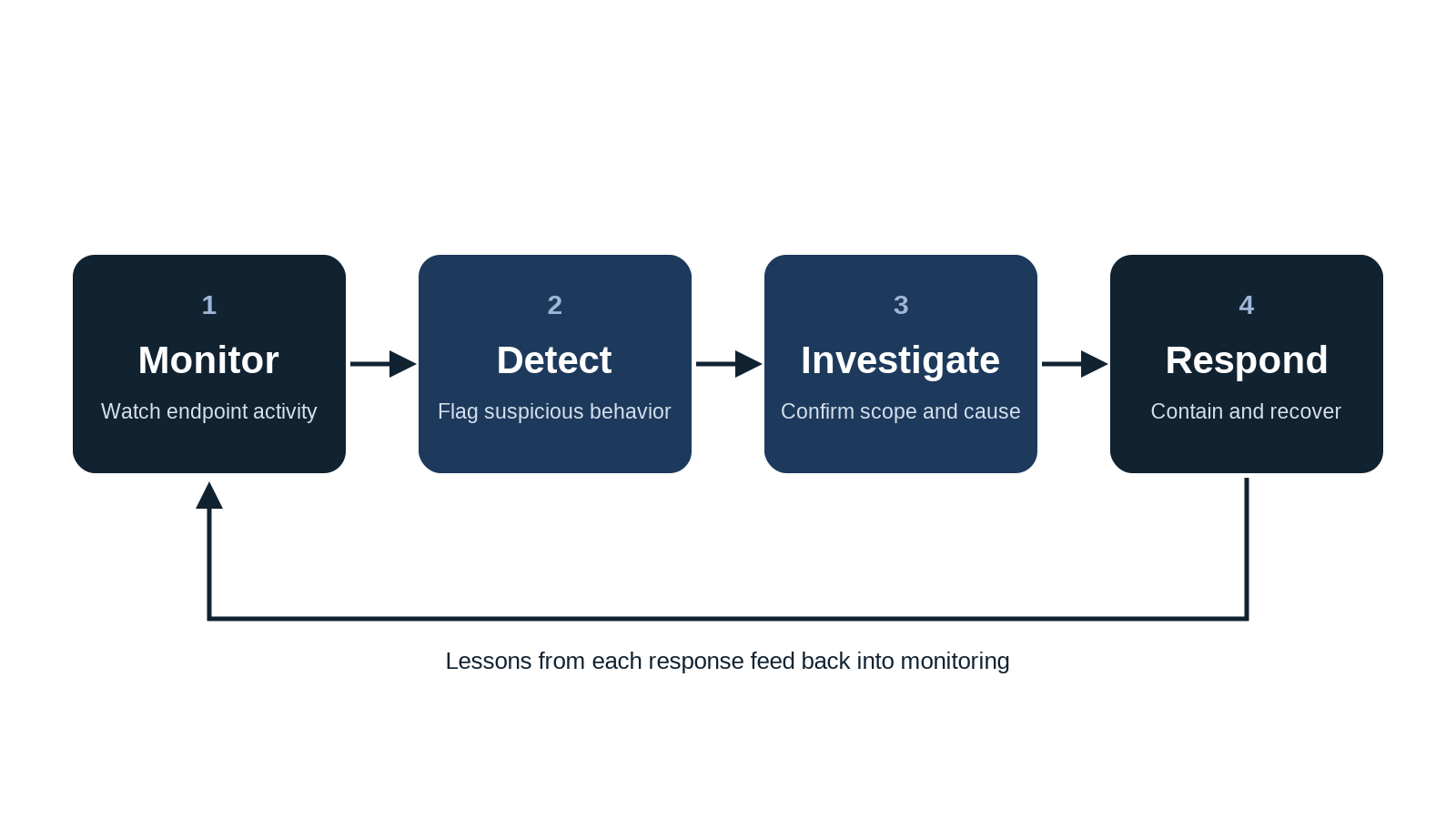
Vendors package EDR differently, but the working loop is the same.
1. Continuous monitoring
A lightweight agent on each device records what happens: which processes start, which files change, which network connections open, which accounts log in. That record is the raw material for detection, investigation and, later, forensics. A device without the agent is a blind spot. In a July 2024 advisory on a federal red-team assessment, the Cybersecurity and Infrastructure Security Agency (CISA) recommended that organizations ensure EDR is installed on all hosts.
2. Detection
The platform compares activity against known malicious patterns and against what is normal for that device or user. A single event may look legitimate. Several events in sequence — a document opens, a script runs, credentials are requested, an unfamiliar server is contacted — can be the start of an intrusion. Detections are often described in a shared language such as MITRE ATT&CK, which catalogs techniques that real attackers use. That mapping is useful for analysts; it is not, by itself, a legal requirement.
3. Investigation
When an alert fires, someone has to answer it. The useful question is not "did a rule fire?" but "what launched this process, what did it touch, and where did it go?" EDR keeps that history searchable. An alert is a question, not a conclusion. A skilled analyst decides whether it is a routine administrator task or the first hour of an intrusion.
This is the step that most often fails in practice. In the same July 2024 advisory, CISA reported that EDR products detected and quarantined several of the red team's tools, including the initial phishing payload, but the organization's daily procedures did not always include review of those alerts. CISA's recommendation was straightforward: make review and handling of EDR alerts part of daily operations, with documented procedures.
4. Response
Containment actions include isolating a device, stopping a process, and quarantining or deleting a file. Some of that can be automated once a detection is confirmed. Speed matters because ransomware can move from one machine to many in minutes, and the gap between detection and containment decides how large the incident becomes.
Because an EDR console can run commands on every protected device, access to it should be tightly limited and protected with multi-factor authentication. CISA has long urged organizations to use multi-factor authentication for users and services; a console with that much reach is a privileged control.
What to expect from a deployment
There is no single standard definition of an EDR product, and capabilities vary. In practice, a deployment that can support both operations and investigation usually includes:
- Continuous recording of endpoint activity, not only alert snapshots
- Detection of suspicious behavior, not only known malware families
- Search and investigation across the collected data, including threat hunting
- The ability to isolate a host and take other containment actions
- A central console, with strong access control
- Support for the operating systems you actually run, including servers and remote laptops
- Retention long enough to investigate, not only to display yesterday's alerts
Coverage is a design choice, not a checkbox. Remote laptops, forgotten servers and unsanctioned devices are the usual gaps. Retention is the other one. If the data is gone when you need a timeline, the tool cannot help a responder or a forensic investigator.
How this differs from antivirus
Traditional antivirus is still useful as a baseline: it checks files against known signatures and blocks what it recognizes. EDR is built for what signatures do not describe — new or custom malware, and attackers who use legitimate tools. Many organizations run both. This article does not retell the EPP, EDR and XDR comparison; that is covered in EPP, EDR, XDR: What Do They All Mean?.
EDR and SIEM: how they work together
People ask whether EDR is part of a SIEM because both appear in security reports. They are separate tools with different strengths.
| EDR | SIEM | |
|---|---|---|
| Main view | Deep activity on individual endpoints | Logs from across the environment |
| Strength | Detecting and containing endpoint threats | Correlating signals from many systems |
| Acts on devices | Yes — can isolate and remediate | Usually identifies; response is handled elsewhere |
A common design is for EDR to send endpoint telemetry to the SIEM, where it can be correlated with other logs. Some programs also use automation so that a confirmed detection can tell the EDR to isolate a host. There is no universal rule for how much endpoint data to send. The right amount depends on how quickly you need to investigate, how long you must retain records, and what storage you have. In a regulated environment, the SIEM may be the place you preserve records in a form that supports later review, while the EDR remains the main response tool. Settle that split before the first incident, not during it.
Seeing beyond the endpoint
EDR sees what happens on the device. Activity that stays in a web application or on the network may never appear clearly on the endpoint, or may appear too late. That is why endpoint monitoring is stronger when it is paired with network security monitoring, so the device and the traffic between devices can be read as one story.
How EDR telemetry supports incident response and forensics
Incident response is the work of detecting, containing, investigating and recovering from a security event. EDR can contribute at each stage — if the alerts are reviewed and the records are retained.
- Detection. It often raises the first alert, sometimes before users notice anything.
- Containment. Isolating a device can stop an attacker from moving to the next one.
- Investigation. The recorded timeline can show the entry point, the accounts used and the files touched.
- Recovery. The same data helps you identify which systems were affected and need rebuilding.
The records matter after containment too. When a breach has to be examined for a regulator, an insurer, counsel or a card brand, endpoint telemetry is often the evidence that digital forensics works from. Intersec's digital forensics and incident response work depends on exactly this kind of record. If you already suspect a compromise and need to know whether an attacker is still inside, a compromise assessment may be the first step.
How long you keep the data decides how far back an investigation can reach. Set retention before an incident. Where PCI DSS v4.0.1 applies, Requirement 10.5.1 requires audit log history to be retained for at least 12 months, with at least the most recent three months immediately available for analysis. Endpoint records that you rely on as audit evidence should meet that bar, and you may need to keep them longer for investigation or other legal obligations.
Common mistakes
- Installing EDR and then leaving the alerts unreviewed. CISA's July 2024 advisory is a public example of that gap.
- Leaving servers, remote laptops or other hosts without an agent.
- Having no written rule for who may isolate a production system, and at what point.
- Setting retention too short to support an investigation, or treating EDR data as disposable once an alert is closed.
- Assuming PCI DSS v4.0.1 requires EDR by name, or that buying a product satisfies the monitoring and response requirements on its own.
EDR and PCI DSS v4.0.1
PCI DSS v4.0.1 does not require EDR by name. What the standard does require, at a high level, is that organizations protect systems from malicious software (Requirement 5), log and monitor access to system components and cardholder data (Requirement 10), and respond immediately to suspected or confirmed security incidents that could affect the cardholder data environment (Requirement 12.10).
EDR can support those expectations when it is deployed, watched and retained properly:
- Malware protection. Requirement 5 expects malware to be prevented, or detected and addressed, and for anti-malware mechanisms to be active and monitored. EDR is one way to detect and contain malicious activity on endpoints, including behavior that traditional signatures miss. It is not a substitute for a complete Requirement 5 program.
- Logging, monitoring and forensics. Requirement 10.2 says audit logs must support detection of anomalies and suspicious activity, and the forensic analysis of events. EDR timelines, alerts and host isolation records can be part of that evidence.
- Incident response. Requirement 12.10.1 requires an incident response plan that is ready to be activated. Requirement 12.10.2 requires that plan to be reviewed, updated as needed, and tested at least once every 12 months. Requirement 12.10.3 requires designated personnel to be available on a 24/7 basis to respond to suspected or confirmed incidents. Requirement 12.10.5 requires the plan to include monitoring and responding to alerts from security monitoring systems — the official list names controls such as intrusion detection and prevention, network security controls and change detection; it does not name EDR. If you run EDR, its alerts still need a documented response, just as other monitoring alerts do.
A few ways this plays out:
- Audit evidence. Endpoint logs and alert histories can show an assessor that monitoring is real and continuous, not only that a product was purchased.
- After a suspected card breach. A PCI Forensic Investigator (PFI) is a company — and its qualified investigators — approved by the PCI Security Standards Council to investigate a suspected or confirmed payment-card compromise, determine root cause, and report to the affected payment brands. A PFI is not a Qualified Security Assessor (QSA). A QSA assesses whether an organization meets PCI DSS; a PFI investigates a breach of cardholder data. Intersec Worldwide is a PCI SSC-approved PFI company. Our PCI Forensic Investigator team can work from your endpoint data, provided it was collected and retained. If logs were never kept, or were overwritten, it may not be possible to establish the exact root cause.
- Ongoing compliance. Our PCI DSS compliance services help you connect the monitoring you run to the controls you must prove.
When managed detection and response makes sense
The real decision for most organizations is not whether to use EDR, but who runs it. An in-house deployment needs analysts for every shift, tuning to cut noise, a response procedure, and someone accountable for coverage. MDR delivers the monitoring and response as a service.
Questions that settle it:
- Who looks at the alert at 2 a.m. on a Sunday? If the answer is "nobody," the technology is not yet protecting you.
- Who has authority to isolate a server? Agree this in advance, in writing, with the owner of each critical system.
- Who investigates? Triage and deep investigation are different skills.
- Which framework are you accountable to? PCI DSS v4.0.1, and other regimes that apply to you, expect evidence you can show.
- How long must you keep the data? Retention affects both investigation depth and cost.
If you already have a staffed, experienced security operations team, a well-run EDR tool can extend it. If you do not, or if the team cannot cover every hour, a managed service closes the coverage gap faster than hiring. Intersec's managed detection and response service includes endpoint monitoring as one part of that coverage.
How we help
Intersec Worldwide is a PCI QSA and PFI firm. We help organizations design and run endpoint monitoring as part of MDR, and we investigate and contain incidents when they occur — including data breach response, ransomware recovery, and PCI forensic investigations.
If you are weighing EDR for the first time, replacing a tool, or already facing an incident, contact Intersec Worldwide and tell us about your environment and your compliance requirements.
FAQ
What is EDR in cybersecurity?
EDR is endpoint detection and response: technology that continuously records activity on devices such as laptops, servers and phones, detects suspicious behavior, and lets responders investigate and contain threats. The US Office of Management and Budget's M-22-01 memo, issued in October 2021, describes it as real-time monitoring and data collection from endpoints, combined with rules-based automated response and analysis.
Is EDR the same as antivirus?
No. Antivirus mainly blocks files it recognizes. EDR watches behavior over time and correlates events, which is how it can identify custom malware and ransomware when each single step still looks legitimate. Many organizations run both. For how EDR relates to EPP and XDR, see EPP, EDR, XDR: What Do They All Mean?
Is EDR part of a SIEM?
They are separate tools that work well together. EDR provides detailed endpoint data and can isolate devices. A SIEM correlates logs from many sources to build the wider picture. Some programs also use automation so that a confirmed detection can trigger a response through the EDR.
Does PCI DSS require EDR?
No. PCI DSS v4.0.1 does not require EDR by name. It does require malware protection, logging and monitoring, and an incident response plan that includes 24/7 designated personnel and monitoring and response to alerts from security monitoring systems. EDR can support those expectations when it is deployed, reviewed and retained, but buying an EDR product is not, by itself, compliance.
How does EDR help incident response and forensics?
EDR can raise the first alert, isolate a host, and keep a searchable timeline of processes, file changes, logins and network connections. That timeline is often the evidence used in incident response and in later forensic review, including after ransomware or a data breach. The records are only useful if alerts are reviewed and the data is retained long enough to investigate.
When does managed detection and response make sense?
MDR makes sense when you need EDR's visibility and response but cannot staff alert review and containment around the clock, or when your team is too small to tune, hunt and investigate as well as watch the queue. The tool does not replace the people. If nobody is looking at the alerts, the deployment is not yet protecting you.
Does EDR help after a suspected payment-card breach?
It can, if the records were collected and kept. A PCI Forensic Investigator uses endpoint and other evidence to determine whether cardholder data was compromised, how it happened, and what the root cause was. Intersec is a PCI SSC-approved PFI company. If EDR data was never retained, or was rotated out, it may not be possible to reconstruct the full timeline.
Sources
- White House / OMB memorandum M-22-01 (October 2021)
- CISA advisory AA24-193A, "CISA Red Team's Operations Against a Federal Civilian Executive Branch Organization Highlights the Necessity of Defense-in-Depth" (11 July 2024)
- CISA, "Implementing Phishing-Resistant MFA" fact sheet (October 2022)
- PCI DSS v4.0.1 (June 2024), PCI Security Standards Council — Requirements 5, 10 (including 10.2 and 10.5.1), and 12.10 (including 12.10.1, 12.10.2, 12.10.3 and 12.10.5). Official distribution: PCI SSC Document Library
- PCI Forensic Investigator (PFI) Program Guide, Version 3.2r1 (November 2021)
